On this page · 6 sections

What drip-feeding is
Drip-feeding is sending links or pages to search engines gradually over a set period rather than in one batch. In link building, "drip feed backlinks" usually means spreading out the indexing requests for a campaign's links so they don't all land on the same day.
FreshlyCited's drip-feed applies that to a push. A push of 300 links dripped over 30 days sends about 10 links a day. The first link goes out straight away, and the rest follow at even intervals.
When to drip-feed, and when not to
Drip-feed when the timing of a batch matters to you or your client. Send at once when it doesn't.
Drip-feed when… | Send at once when… |
|---|---|
A link-building campaign delivers many links on the same day, and you prefer a steady pace | You updated a pricing, product or launch page and want Google to look now |
You're rolling out a large set of new or programmatic pages | It's a small batch of links |
A client asks for links to be spread across the month | The links are time-sensitive (news, events, launches) |
You want to manage credit spend across a campaign | You need a result to report this week |
To be clear about what it does: Google hasn't published any rule that requires drip-feeding, and we don't claim it changes rankings or makes links "look natural". Agencies use it to keep link velocity steady and to spread work across a campaign. We give you the control; the decision is yours.
How drip-feed works in FreshlyCited
Drip-feed is an option on any push, under Advanced. Here's what happens, step by step:
- Paste or upload links, up to 10,000 per push with any pack or Agency plan (50 on Free). Duplicates and invalid lines are removed.
- Choose drip-feed and a number of days, from 1 to 30.
- The check runs first. With smart push, every link is checked before anything is sent. Links Google already sees aren't sent, so no index credit is reserved for them, and only the invisible ones join the drip.
- FreshlyCited spreads the sending evenly across the days you chose, until the drip completes.
- Each link is re-checked on days 1, 3 and 7 after it's sent, so in a long drip the early links are re-checked while later ones are still going out. The re-checks are included, and you get an email with the result.
One index credit is reserved for each link that will be sent when you start the push, and it's used only if that link is indexed. If a link still isn't indexed after its own day-7 re-check, its credit comes back automatically. If you cancel a drip partway through, every link that hasn't been sent yet gets its reserved credit back.
Large link lists and programmatic pages
Drip-feed is most useful for long lists: a quarter's worth of backlink indexing for a client, or the first few thousand pages of a programmatic SEO rollout.
For programmatic pages, a drip pairs well with publishing in batches. Publish a batch, link it from your hub pages, drip the push over a week or two, and check how many pages Google has seen before publishing the next batch. If few are being seen, that's a signal to improve the template, not to push harder.
Tracking progress and re-checks
While a drip is running, the push page shows how many links have been sent, how many are still waiting and when the next one goes out. Re-checks run alongside, since each link's days 1, 3 and 7 count from when that link was sent. Once the last link's day-7 re-check is done, every credit is settled, and the outcome reads in plain words, for example "212 of 300 seen by Google (+130)" (illustrative).
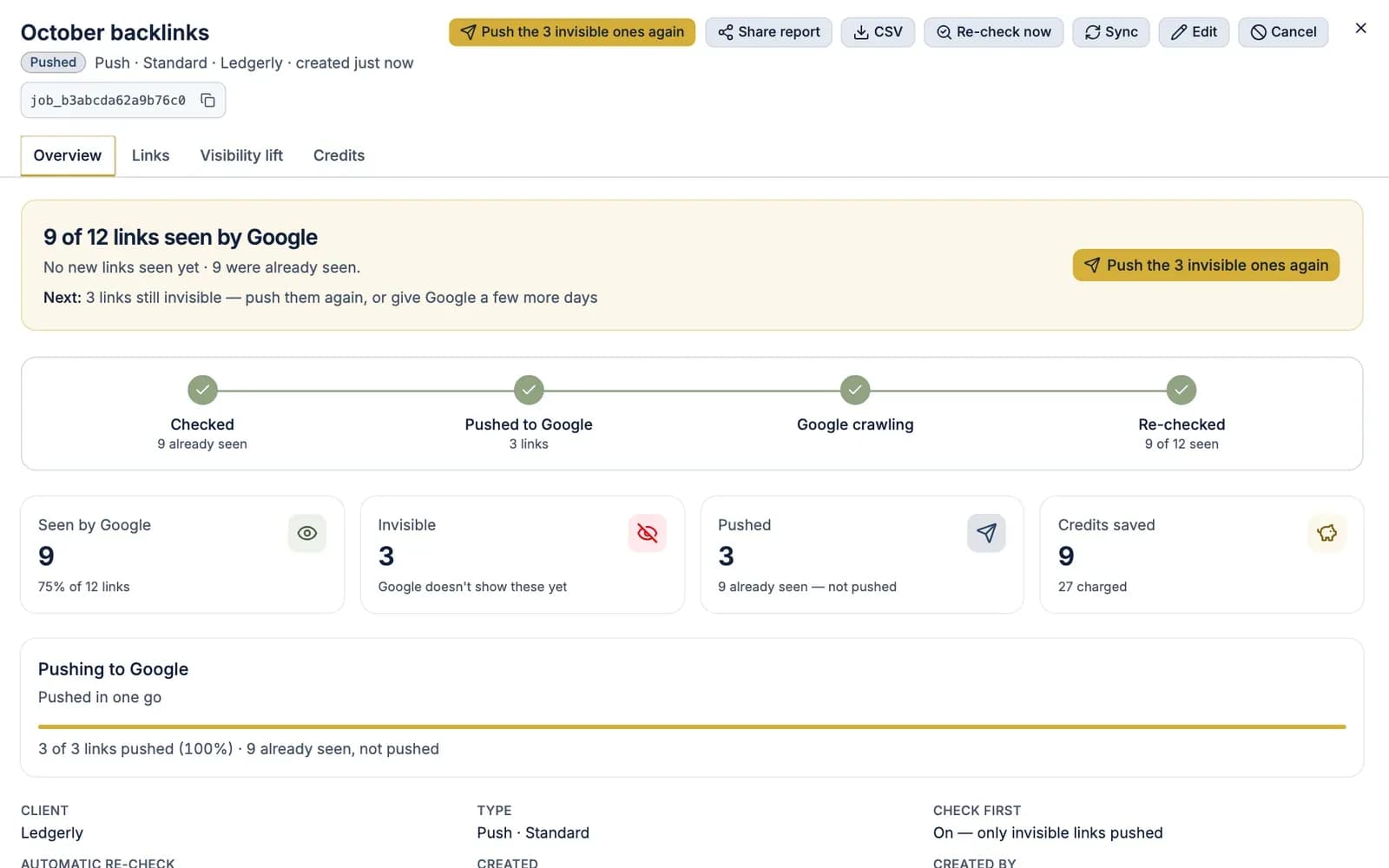
From there you can push the remaining invisible links again in one click, with or without another drip, or share a report with your client showing each link's before-and-after status (your logo on Agency plans; fully white-label on Agency Pro and Scale).
Drip-feed over the API
Drip-feed is available over FreshlyCited's REST API with any pack or Agency plan, and through the MCP server on Agency Pro and Agency Scale: set the number of drip days (1 to 30) when you create a push. That makes it easy to drip every link a supplier delivers, or every page your CMS publishes, without touching the app.
What it costs: the same as any push. Each link sent reserves 1 index credit, used only if it's indexed: indexed or your credit back. The smart check costs 1 check credit per link, and the re-checks on days 1, 3 and 7 are included. Drip-feeding adds nothing. Pages that are dead, noindex, blocked, redirected or canonicalised elsewhere aren't covered, so the pre-flight check flags them first. Packs start from $0.16 per indexed link; see pricing, or start free while payments open soon.
Who it's for: link builders and agencies running steady campaigns, and teams launching large page sets. See FreshlyCited for link builders, or check your own links free.

Written by