On this page · 7 sections

AI answers cite what's been crawled, and they lean toward pages that are kept current. FreshlyCited asks Google to crawl the pages, posts and links you've published or updated, then re-checks and shows you which ones Google has indexed: the first step to being eligible for Google Search, AI Overviews and AI Mode. This page covers what to push, how to automate it, and what FreshlyCited can and can't do for a SaaS site.
Your product changed. Search and AI answers haven't noticed.
A SaaS product changes every few weeks, but Google's copy of your site can lag by days or weeks. Google's documentation says crawling "can take anywhere from a few days to a few weeks" (Google: Ask Google to recrawl), and Google AI Overviews and AI Mode can only show pages that are in Google's index as supporting links (Google Search Central).
Picture it (illustrative): a prospect asks an AI assistant "Does [your product] integrate with HubSpot?" and the answer is built from the version of your integrations page a search engine saw months ago. Your new pricing tier doesn't exist yet as far as search is concerned. None of this is a content problem. It's a timing problem, and it sits between "published" and "seen."
The research backs the direction, if not a magic number: in one 2026 study of four brands, 75% of pages cited by ChatGPT, Gemini and Perplexity had been updated within the past year, and the study found that "the freshness LLMs reward is being manufactured by updates, not by new publishing" (Seer Interactive). It's a correlation, not proof that updating causes citations. Read more in our guide to content freshness and AI answers.
What to push after every release
Push anything you changed that should count. A release checklist for most SaaS teams:

Page type | Why it matters |
|---|---|
Pricing page | Prospects and AI answers quote plans and prices |
Comparison and alternatives pages | Answer "X vs Y" and "alternative to X" questions |
Feature and product pages | Describe what the product does now |
Docs and help articles | Answer "how do I…" questions directly |
Changelog and release notes | Show the product is current |
Integration pages | Answer "does X work with Y" queries |
Earned backlinks and directory listings | Third-party pages that mention you |
Don't push pages that haven't changed. Google uses a sitemap's lastmod only when it's "consistently and verifiably" accurate (Google sitemaps guide), and Bing asks that lastmod reflect "the true last modification time of the page content" (Bing Webmaster Blog). For the wider strategy, see our SEO for SaaS playbook.
Comparison and alternatives pages in AI answers
Comparison and alternatives pages answer the questions buyers ask late in a decision, such as "X vs Y" or "best alternative to X," and AI answers to those questions can only cite pages that have been crawled. When you update one, the stale version stays in Google's index until Google crawls it again.
Push those pages the day they change, and check them again after the re-check. If you publish "Your product vs Competitor" and Google hasn't seen it, it can't be a supporting link in AI Overviews. FreshlyCited doesn't decide whether a page gets cited; quality, authority and relevance still do that. Being crawled sooner makes a page eligible sooner, and that's the step FreshlyCited handles. Our ChatGPT SEO guide covers the other factors.
Docs, changelogs and integration pages
Docs, changelogs and integration pages change most often and get crawled least. They're also the pages that answer specific product questions, which is exactly what people ask AI assistants.
A practical routine:
- When a release ships, collect every URL it touched: the changelog entry, the docs pages it changed, any new integration page.
- Paste them into FreshlyCited, or send them from your release pipeline (see the next section).
- Smart push checks each URL, pushes only the ones Google can't see, and reserves no index credit for the rest.
- FreshlyCited re-checks on days 1, 3 and 7 and emails the result. If a pushed page still isn't indexed after day 7, its index credit comes back.
Push on publish with the API or MCP server
FreshlyCited's REST API exposes everything the app does: pushes, checks, workspaces and credits. The full API comes with any pack or Agency plan (read-only on Free), and the MCP server comes with Agency Pro and Agency Scale. That makes "push on publish" a small integration rather than a weekly chore.
Typical setups:
- CMS webhook: when a page is published or updated, send its URL to FreshlyCited as a smart push.
- Release pipeline: after a deploy, push the changed docs and changelog URLs.
- AI assistant: on Agency Pro or Agency Scale, connect an MCP-capable assistant and ask it to check last week's posts and push the invisible ones.
Updated pages Google already has. The pre-flight check skips them by default, so no credit is used. To ask for a re-crawl anyway, choose Refresh anyway: the page is sent and uses 1 index credit when it's sent, with no credit back, because we can't see when Google re-crawls a page it already has. IndexNow notifications to Bing (for verified sites) stay free.
See the API and MCP server page for the endpoints and tools. Smart push is opt-in on the API, so set it explicitly.
Programmatic pages at scale
Programmatic pages (templates for integrations, use cases, locations or comparisons) create hundreds or thousands of URLs at once, and Google often gets to only some of them. FreshlyCited takes up to 10,000 links per job with any pack or Agency plan (50 on Free) and can drip-feed them over 1 to 30 days so a large launch isn't sent in one burst.
Check a sample first. If most of a template's pages stay invisible after a push and a re-check, the problem is usually the template (thin or near-duplicate content), not the crawl. Our programmatic SEO guide covers how to tell the difference.
Check what Google has seen
A visibility check tells you, for each URL, whether Google has seen it, for one check credit per link. A Live check returns the result in seconds for 5 check credits. It's the quickest way to answer "is our new pricing page in Google yet?" without opening Search Console one URL at a time.
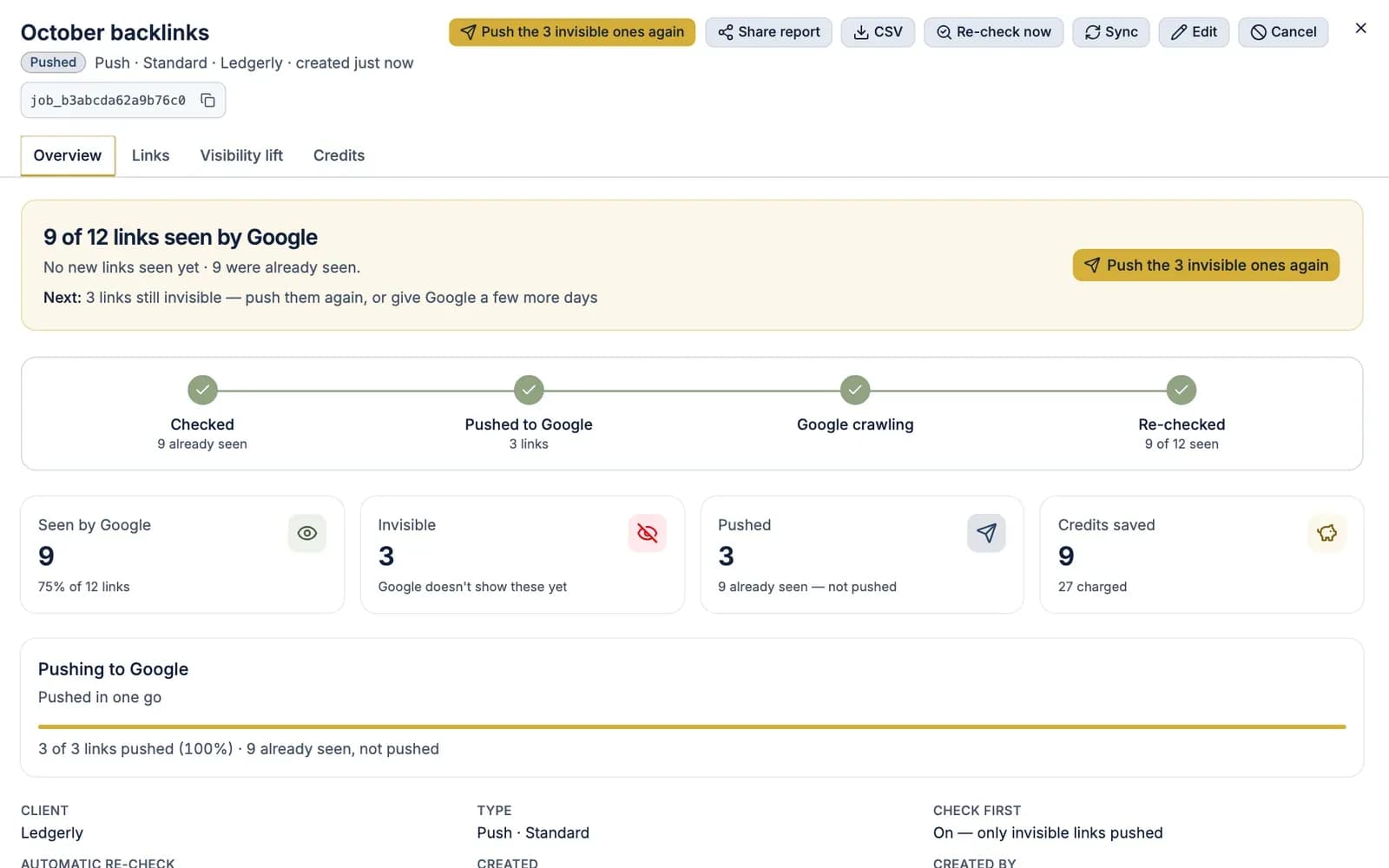
Pricing fit: an index credit sends one URL for indexing. It's reserved when you submit and used only if the page is indexed; if it still isn't after the day-7 re-check, the credit comes back. Google sets the pace (Google says crawling can take a few days to a few weeks); we re-check on days 1, 3 and 7. Pages that return errors, are noindex, blocked by robots.txt, redirected or canonicalised elsewhere use their credit, so the pre-flight check flags them before you send. Index checks use separate check credits. Pay-as-you-go packs start from $0.16 per indexed link, with index checks from $0.004, and Agency plans are monthly; see pricing. As an illustration, a team shipping 100 changed URLs a month reserves up to 100 index credits, uses only those that get indexed, and adds 100 check credits if it pre-checks them. The re-checks are included.
Bing and Copilot too: for sites you verify with an IndexNow key file, FreshlyCited can submit the same URLs to IndexNow alongside the Google push, at no extra credit cost. That reaches Bing and other participating engines, and Microsoft says Copilot's web answers use the Bing search service. It doesn't reach Google. ChatGPT, Perplexity and other assistants use their own crawlers and search partners; we don't submit to them, and we don't claim to. See how it pairs with a Google push on the smart push page.
Start free: 10 free links to try once you verify your email, then 100 free checks a month, with no card. Check your own links free.

Written by