On this page · 9 sections
- 01Published or updated, but not yet indexed
- 02How smart push works: check, push the invisible, re-check
- 03Never pay to push what Google already sees
- 04Indexed or your credit back: re-checks on days 1, 3 and 7
- 05Pages, posts and backlinks in one flow
- 06Built for Google's AI answers: fresh pages, crawled sooner
- 07Pair IndexNow with a Google push
- 08What happens after you push
- 09What we don't promise

Published or updated, but not yet indexed
New pages, updated pages and new backlinks don't count until Google looks at them, and Google decides when that happens. Its own documentation says crawling "can take anywhere from a few days to a few weeks" (Google: Ask Google to recrawl). Until then, the work earns no rankings, no traffic and no place in AI answers built on search.
A submit-everything indexer sends every URL you paste and charges for all of it, including links Google already has and links that never get indexed. Then it leaves you to find out what happened (our comparison of Google indexing tools shows how the main options differ). Smart push starts with a check and ends with re-checks, so you know what changed, and you only pay for links that made it in. It speeds up discovery; it doesn't make a page worth indexing. Good, current content that Google has indexed is what makes a page eligible for search and AI answers.
How smart push works: check, push the invisible, re-check
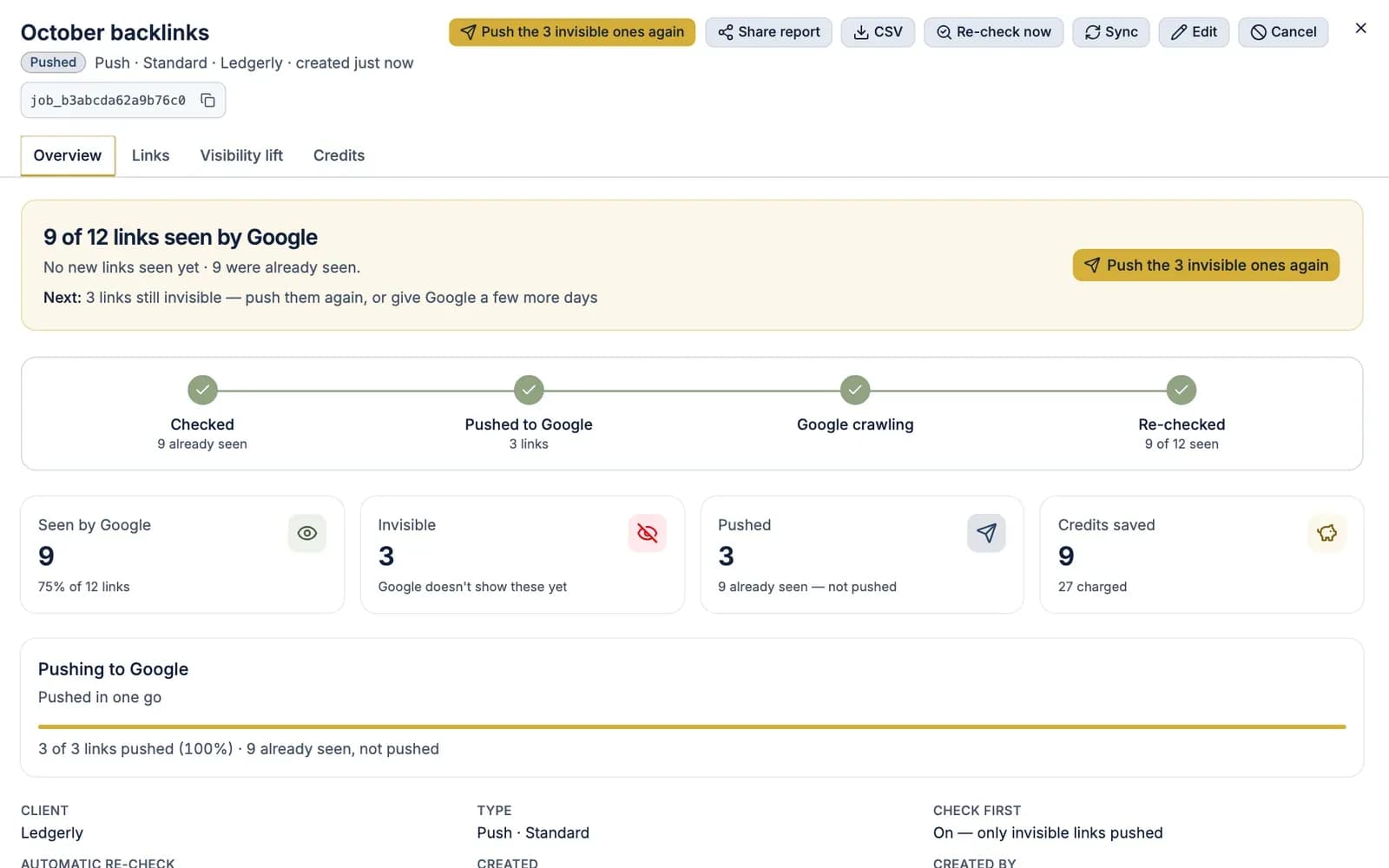
Smart push runs four steps automatically after you click one button.

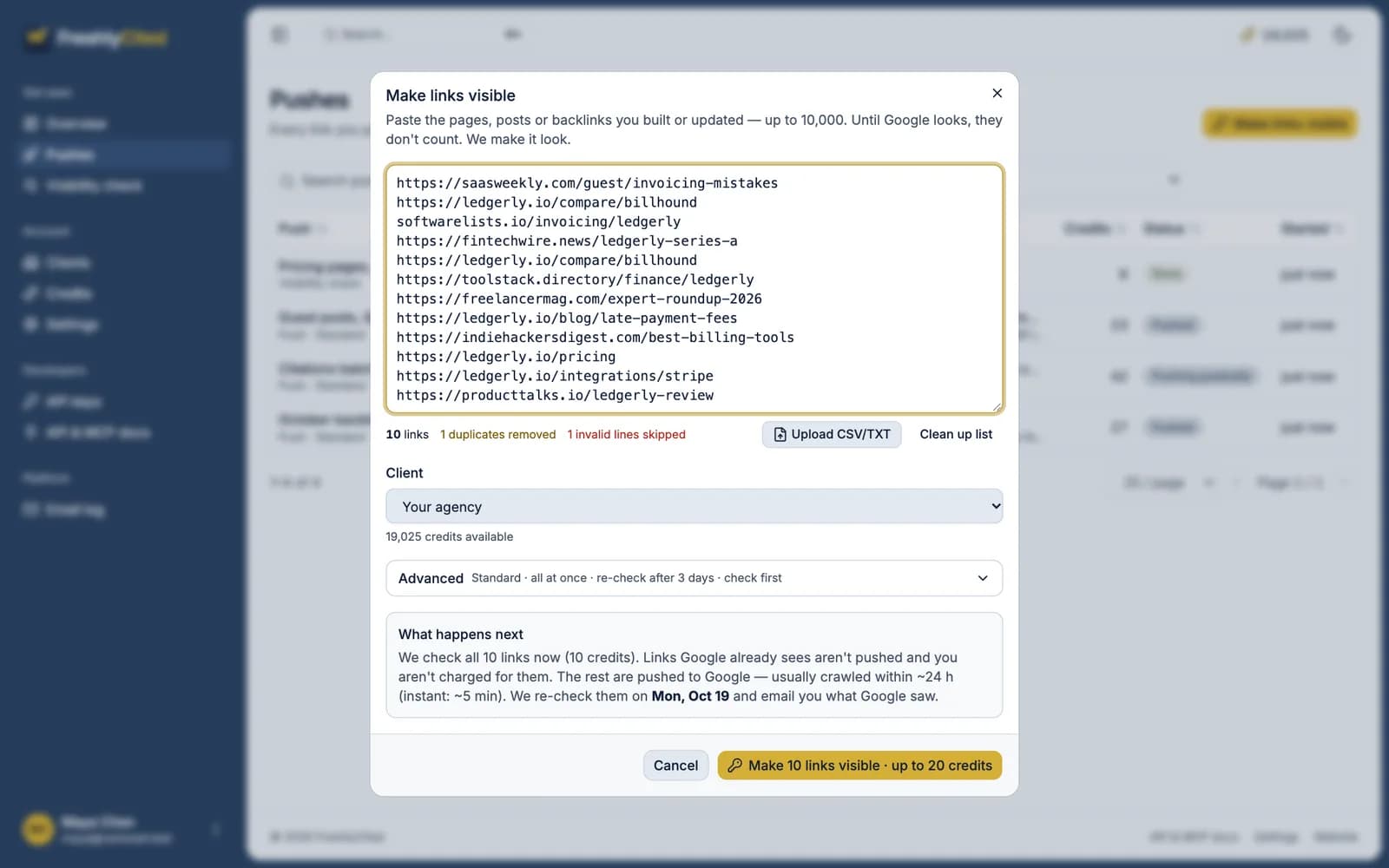
- Paste or upload links. Up to 10,000 per push with any pack or Agency plan (50 on Free). Duplicates and invalid lines are cleaned out first, and a pre-flight check flags pages that can't be indexed (dead,
noindex, blocked, redirected) so you can skip them for free. - Check. FreshlyCited checks every link against Google, at 1 check credit per link. Each one comes back as Seen by Google, Invisible or unknown.
- Push the invisible ones. Links Google already sees aren't sent, so no index credit is reserved for them. Invisible and unknown links are sent for indexing, and one index credit is reserved for each.
- Re-check on days 1, 3 and 7. FreshlyCited checks every sent link again on days 1, 3 and 7 and emails you the result. The re-checks are included, and if a link still isn't indexed after day 7, its index credit comes back automatically.
What you see at each stage:
Stage | What the push page shows |
|---|---|
Checking | "Checking 40 links…" |
Pushed | "21 links pushed to Google · 19 already seen, not sent" |
Crawling | When the next re-check is scheduled |
Result | "33 of 40 seen by Google (+14)", plus a one-click Push again for any still invisible |
Numbers above are illustrative. If the check itself can't run, FreshlyCited sends every link rather than none and gives back the check credits for the checks that didn't happen.
Never pay to push what Google already sees
Links Google already sees are never sent, so they never use an index credit. You spend 1 check credit to find that out, which costs far less than pushing a link that's already indexed. On many backlink lists, some links are already indexed by the time you get to them, and pushing those again costs money and tells you nothing.
You can also cancel a push that's still running or drip-feeding. Links that haven't been sent yet get their reserved credit back.
Indexed or your credit back: re-checks on days 1, 3 and 7
Every link you send is covered by the same rule: indexed or your credit back. One index credit sends one URL for indexing. The credit is reserved when you submit and used only if the link is indexed. FreshlyCited re-checks each sent link on days 1, 3 and 7. If a link still isn't indexed after the day-7 re-check, its credit returns to your balance automatically.
There's one speed, and we make no timing promise: Google sets the pace (Google says crawling can take a few days to a few weeks), and it still decides what it keeps. We re-check on days 1, 3 and 7, and the day-7 re-check is what settles each credit.
| What happens |
|---|---|
Link already seen by Google | Not sent. No index credit used. |
Link sent and indexed by the day-7 re-check | 1 index credit used |
Link sent and still not indexed after day 7 | Credit comes back automatically |
Page is 404/410/5xx, | Not covered: the credit is used. The pre-flight check flags these first so you can skip them for free. |
For example (illustrative), 200 links pre-checked cost 200 check credits. If 50 are already seen, the other 150 are sent and up to 150 index credits are reserved. Only the ones indexed by day 7 are used; the rest come back after the day-7 re-check. Check credits aren't refundable, because the check is the product.
Pay-as-you-go packs start from $0.16 per indexed link, and index checks from $0.004. Agency plans add monthly credits for client work. You can start free: 10 free links to try once you verify your email, then 100 free checks a month, no card. See pricing.
Pages, posts and backlinks in one flow
Smart push works on any public URL, so one flow covers your own pages and links on sites you don't control:
- New and updated pages on your site: pricing, comparisons, docs, changelogs.
- Blog posts and guest posts.
- Backlinks, citations and directory listings on other people's sites. No Search Console access needed.
Updated pages Google already has. The pre-flight check skips them by default, so no credit is used. To ask for a re-crawl anyway, choose Refresh anyway: the page is sent and uses 1 index credit when it's sent, with no credit back, because we can't see when Google re-crawls a page it already has. IndexNow notifications to Bing (for verified sites) stay free.
Agencies can run pushes inside client workspaces, so credits and results stay separate per client. For long lists, drip-feed pushes spread the sending over 1 to 30 days. Read more on why links need this in our backlink indexing guide.
Built for Google's AI answers: fresh pages, crawled sooner
Google still sends about 9 in 10 of the visits that search engines send to websites worldwide (StatCounter, September 2026), and its AI answers are built on its index. Google's rule is simple: to appear as a link in AI Overviews or AI Mode, a page must be "indexed and eligible to be shown in Google Search with a snippet" (Google Search Central). Smart push helps your new and updated pages get found and indexed by Google sooner, so they become eligible sooner, and the version Google's AI answers work from is the current one. Being indexed is the first step. Whether an AI answer cites your page still depends on quality, relevance and authority.
That matters most for pages you've refreshed. In one 2026 study of four brands, 75% of pages cited by ChatGPT, Gemini and Perplexity had been updated within the past year (Seer Interactive). Push a page when its content has actually changed, not to make an unchanged page look fresh. See why freshness matters for AI answers and our AI search optimization hub.
Pair IndexNow with a Google push
For sites you've verified by hosting an IndexNow key file (FreshlyCited generates it for you), every push also submits your URLs to IndexNow automatically, alongside the Google push and at no extra credit cost. You can switch it off per site. Only URLs on the verified site are submitted: IndexNow requires you to control the host, so backlinks on other people's sites go to Google only. IndexNow is an open protocol for telling search engines a URL has been added, updated or removed, and a submission is shared with every participating engine. As of October 2026, indexnow.org lists Microsoft Bing, Naver, Seznam.cz, Yandex and Yep, plus an Amazon endpoint.
It's a free bonus on top of the Google push: Microsoft says Copilot's web answers use the Bing search service (Microsoft Learn), and it says "freshness signals directly influence how quickly updates are reflected in search results and AI generated answers," and recommends IndexNow for real-time URL submission (Bing Webmaster Blog).
What IndexNow doesn't do:
- It doesn't reach Google. Google isn't among the participating engines, which is why the Google push still matters.
- It doesn't reach Perplexity, which isn't listed as a participant either.
- It doesn't reach ChatGPT. ChatGPT, Perplexity and other assistants use their own crawlers and search partners. We don't submit to them, and we don't claim to.
Like a Google push, an IndexNow submission tells engines to look; it doesn't guarantee crawling or indexing, and the IndexNow FAQ says so too. Index checks, before-and-after reports and the credit-back rule in FreshlyCited cover Google only. Read more in our Bing and IndexNow guide.
What happens after you push
After a push, the push page shows when the next re-check runs. After each re-check on days 1, 3 and 7, the page updates to show which links are now seen by Google and which are still invisible, and you get an email with the outcome. Once the day-7 re-check is done, every credit is settled: used for indexed links, back in your balance for the rest.
From there you can:
- Push again the links that are still invisible, in one click.
- Share a report with your client: a link with each link's before-and-after status, branded by plan.
- Run a visibility check any time to see where things stand.
If links stay invisible after a push, the cause is usually the page itself: thin content, a noindex tag, or a site Google rarely crawls. Our Google indexing guide covers how to diagnose it.
What we don't promise
We don't promise indexing, rankings or AI citations, and nobody honest can. A push asks Google to look. Google decides what it keeps and where it ranks it, and each AI engine chooses its own sources. What we do promise is how you're charged: indexed or your credit back. Google sets the pace (Google says crawling can take a few days to a few weeks); we re-check on days 1, 3 and 7. Indexing is the first step, and being cited still depends on quality, authority and relevance.
What you get is a record of each link's indexed status, before and after, link by link. Running releases? See smart push for SaaS releases, or check your own links free.

Written by